
Your Brain Is Still Developing in Your 30s, and That Changes Everything
March 16, 2026
Is Virtual Cognitive Rehabilitation Therapy as Effective as In-Person? The Research May Surprise You
April 16, 2026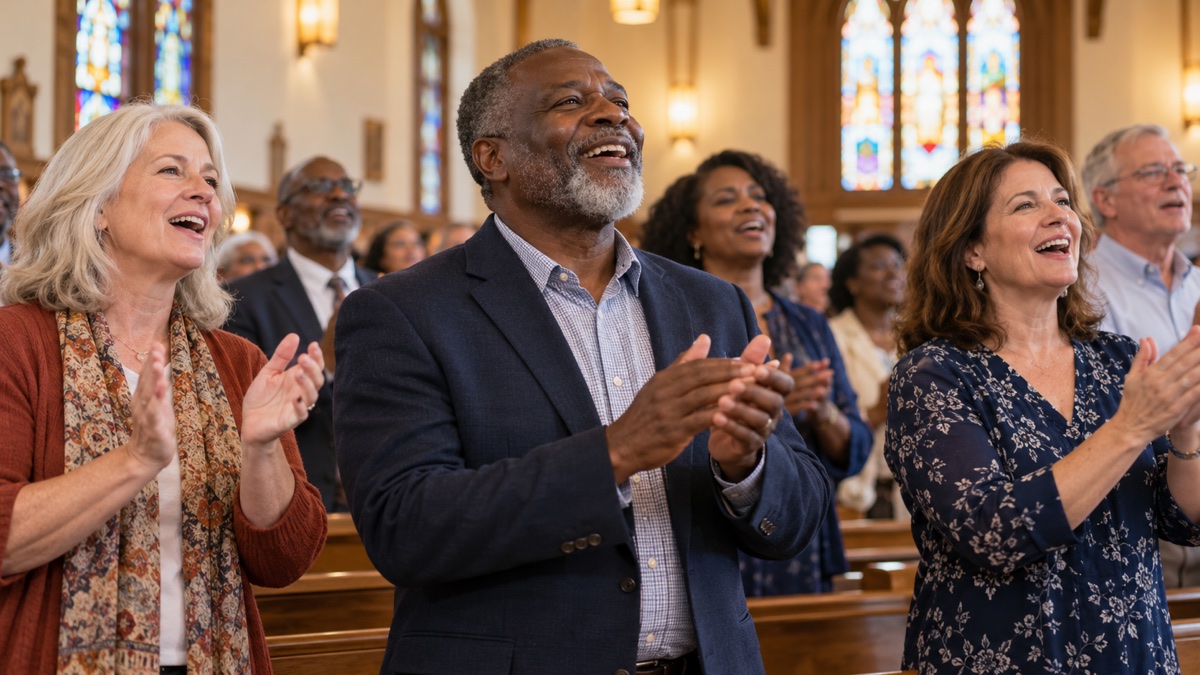
Think about your rhythm of the week. In the morning you get up a little earlier, put on something nicer, and head to your place of worship. Maybe it’s Sunday service, a Saturday Shabbat service, or the communal gatherings of Ramadan. Maybe it’s the High Holy Days that bring your family together every fall, or Easter Sunday morning that marks a season of renewal. You go for your faith and for the people, and you go because, whether you’ve ever put it into words or not, something about that rhythm makes your week feel grounded.
What you may not have realized is that in showing up the way you do, you are also checking off nearly every box that research identifies as protective for your brain and your mental health.
This is not a metaphor or a loose connection. The structure, the belonging, the purpose, the meaningful connection with other people, these are the exact factors that neuroscience and psychology have identified as most protective for your brain and emotional health over time.
My goal here isn’t to turn your spiritual life into a clinical checklist, and it isn’t to dismiss what faith means at a deeper level. It’s about recognizing that what you’re already doing matters in more ways than you may have known.
What Your Brain Needs to Stay Sharp, and What Faith Communities Naturally Provide
If you’ve read my earlier writing on what happens to the brain after retirement and the lifestyle factors most protective for cognitive health after 60, you’ll recognize a theme that runs through both: your brain thrives on routine, active social engagement, a sense of purpose, and meaningful connection with other people. What I find genuinely interesting, and worth naming directly, is that regular participation in a faith community delivers all four of those things in a single weekly practice.
The weekly rhythm of showing up provides the structure your brain depends on. The conversations, the relationships, the act of being present with people you know and care about, these are forms of active cognitive engagement that research consistently identifies as protective.
And belonging, the felt experience of being known and mattering to a group, is something researchers have begun to take seriously as a health variable in its own right, not just a nice feeling, but a measurable protective factor. Faith communities offer all of this, along with a built-in sense of purpose that is woven into the very nature of what they are.
What the Research Actually Shows About Social Engagement and Your Brain
The evidence here is substantial and growing. In December 2025, researchers at the University of St. Andrews published a study in The Journals of Gerontology that found a direct causal link between social isolation and faster cognitive decline, and they specifically measured religious participation as one of the markers of protective social engagement.
This builds on a 2024 meta-analysis published in World Psychiatry examining data from more than 2.3 million participants, which found that smaller social networks, low frequency of social contact, and limited social support were consistent risk factors for dementia — while greater social engagement and community participation were associated with lower dementia risk.
The research was clear that it’s not just about having people in your life in a general sense. It’s about active, regular, meaningful participation in a community.
That distinction between active participation and passive social contact matters. Scrolling through a social feed, watching television, or having occasional phone calls is not the same thing, cognitively speaking, as showing up to a place where people know your name, where you’re expected, and where real conversation and connection happen.
Your Faith Community Is Also Quietly Supporting Your Mental Health
The cognitive health benefits of faith community participation are meaningful on their own. But the mental health piece of this conversation is equally important, and the two are more connected than many people realize.
A longitudinal study published in Religion, Brain & Behavior followed more than 7,500 people over eight years and found that consistent church attenders showed a more adaptive trajectory of mental distress over time compared to those who did not attend regularly — notably, even though consistent attenders started with higher baseline distress levels, suggesting the effect is real and not simply explained by measuring those who were already doing well.
Importantly, the protective effect was especially pronounced for people already navigating difficult circumstances. Faith community participation appeared to buffer against the accumulation of distress even among those carrying real burdens.
This tracks with what researchers who study religious and spiritual coping have found more broadly. As part of my own continuing education, I’ve been deepening my understanding of this area through a course developed by Dr. Jessica Lewis through the National Register of Health Service Psychologists, focused on the impact of religious and spiritual coping on trauma. What that work highlights is how faith frameworks provide built-in tools for navigating adversity, including a sense of meaning, community accountability, and structured ritual that helps people process and move through difficult experiences rather than becoming stuck in them.
This applies across traditions. Whether someone finds that structure in the liturgical rhythm of certain sects in the Church, in the observance of Shabbat and the Jewish calendar’s cycle of sacred seasons, or in the shared worship of a faith community, the underlying mechanisms appear to be similar: belonging to something larger than yourself, having a framework for meaning-making, and being held within a community that knows you all genuinely matter for mental health.
I want to be clear that this is not about one tradition being more protective than another. The research points to participation, consistency, and felt belonging as the active ingredients.
Why a Strong Faith Community and a Cognitive Screening Can Coexist
There is something I want to name directly, because I think it matters and it doesn’t always get said. Having a strong faith community around you is genuinely protective. It is also true that community can sometimes make it easier to dismiss subtle changes, because you feel connected, because people tell you that you seem fine, because you are still showing up and participating and that feels like evidence that nothing is wrong.
I approach my work with this in mind. When someone comes to see me, I am not just looking at clinical symptoms in isolation. I am interested in the whole picture of a person’s life, including their social connections, their sense of purpose, their community involvement, and yes, their faith life. These things are not separate from cognitive health. They are a part of it.
If you’ve been noticing changes that feel different from normal forgetfulness, or if someone close to you has gently raised a concern, I’d encourage you to bring that question somewhere rather than carry it quietly. A free 10-minute consultation is a good place to start. We can talk through what you’re noticing and whether any next steps make sense.
A cognitive screening or assessment is genuinely useful at many points in life, not only when something feels wrong. Some people come to see me to establish a baseline while they are cognitively sharp. Others come because they are moving through a significant transition, or because a family history of memory impairment makes them want to be proactive. And some come because something has felt different lately and they want real information rather than worry or guesswork. Whatever brings you to that conversation, objective data is almost always more useful than wondering.
I offer both brief cognitive screening and comprehensive assessment, along with psychotherapy for people navigating anxiety, difficulty coping with stress, life transitions, or the emotional weight that sometimes accompanies cognitive concerns. These services are available in person at my Garden City office on Long Island, and virtually for clients throughout New York State and Georgia. Schedule a free 10-minute consultation here and we can talk through what makes sense for your situation.
Your Faith Community Has Been Supporting Your Cognitive Health All Along
Every time you walk through those doors where your community gathers in faith, you are doing something your brain genuinely benefits from.
You are maintaining routine, engaging in real and meaningful social connection, and participating in something that gives your week structure that research consistently identifies as protective.
Request a private, complimentary 10-minute consultation.
About Dr. Rebecca A. Steele
Dr. Rebecca Steele is a licensed clinical psychologist with advanced training in neuropsychology. She provides cognitive screening and assessments and psychotherapy in-person at her Garden City office on Long Island and virtually throughout New York State and Georgia. As a National Register Health Service Psychologist, Dr. Steele brings both clinical expertise and neuropsychological insight to help you understand your cognitive health and support your overall wellbeing.